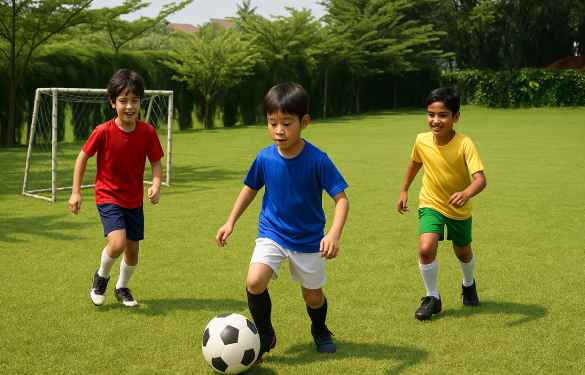
When parents first enroll their children in a football school, the focus often seems simple — to help them play better, move faster, or become more confident with the ball. But as the weeks go by, something deeper begins to unfold. The children don’t just learn how to play football — they learn how to grow through it.
Football as a Journey of Growth, Not Just Performance
For many children, football becomes their first encounter with commitment. They learn that progress is not instant but earned through repetition, patience, and effort. What begins as physical training gradually becomes a lesson about consistency. The act of showing up, even on days when they feel tired or discouraged, teaches them perseverance, a value that extends far beyond the field. In this way, football turns into a quiet mentor that shaping their attitude toward challenge, success, and improvement. The goal is no longer just to become a better player but to become a stronger version of themselves.
An Open-Air Classroom Without Walls
Unlike a traditional classroom, the football field does not rely on textbooks or long explanations. Here, learning comes through action. Children don’t just hear about teamwork, they experience it. They don’t read about resilience; they live it every time they fall and get back up again. The natural environment of play creates a space where values sink in organically. A missed goal teaches patience. A successful pass teaches trust. Every mistake becomes a moment of self-reflection, and every achievement becomes a shared celebration. Children often don’t realize they are “learning” at all — yet with each session, they internalize lessons about communication, empathy, focus, and responsibility.
Winning, Losing, and Learning to Stand Tall
On the field, children inevitably face both victory and defeat. These moments quietly shape emotional maturity. Winning teaches them gratitude — to celebrate without arrogance — and losing teaches them grace — to accept outcomes without anger or blame. This emotional balance is one of the earliest forms of character formation that sports can provide.
Teamwork as a Foundation for Character
Football allows children to realize that no achievement is ever accomplished alone. They learn to trust others, to depend on a teammate, and to understand that each person has a role that contributes to the bigger picture. The shift from “I” to “we” is one of the most meaningful transformations that sports can nurture in a child.
Mentorship Beyond Technique
Coaches play a vital role, not only in shaping skill, but in guiding attitude and mindset. To the children, a coach becomes more than a technical instructor — they become a mentor, a steady figure who provides encouragement, structure, and emotional support. Through this relationship, children learn respect, humility, and self-belief.
A Place Where Football Becomes Formation
This philosophy is what makes PIGA Football School more than just a training venue. It is a safe and nurturing environment where children are guided not only to improve their skills, but to build character, confidence, and emotional readiness for the world beyond sports. And importantly, PIGA is open not only to residents, but also to participants from outside the community. Families from beyond the area are welcome to join and experience this unique blend of sport and character education.
If you wish for your child to learn life values through movement, teamwork, and real experiences — not only through words — PIGA offers a space where growth happens naturally, joyfully, and meaningfully. You are welcome to visit a session or contact PIGA to learn more about training schedules and registration. Because here, football is not merely a game — it is a foundation for who children can become.